Case file
Ariel School 1994
September 16, 1994 · Ariel School, Ruwa, Zimbabwe
On September 16, 1994, roughly sixty Ariel School pupils in Zimbabwe said they saw a craft near the brush and one or more figures nearby. The drawings, early interviews and later public attention made the case one of the most discussed school sightings in UFO history.
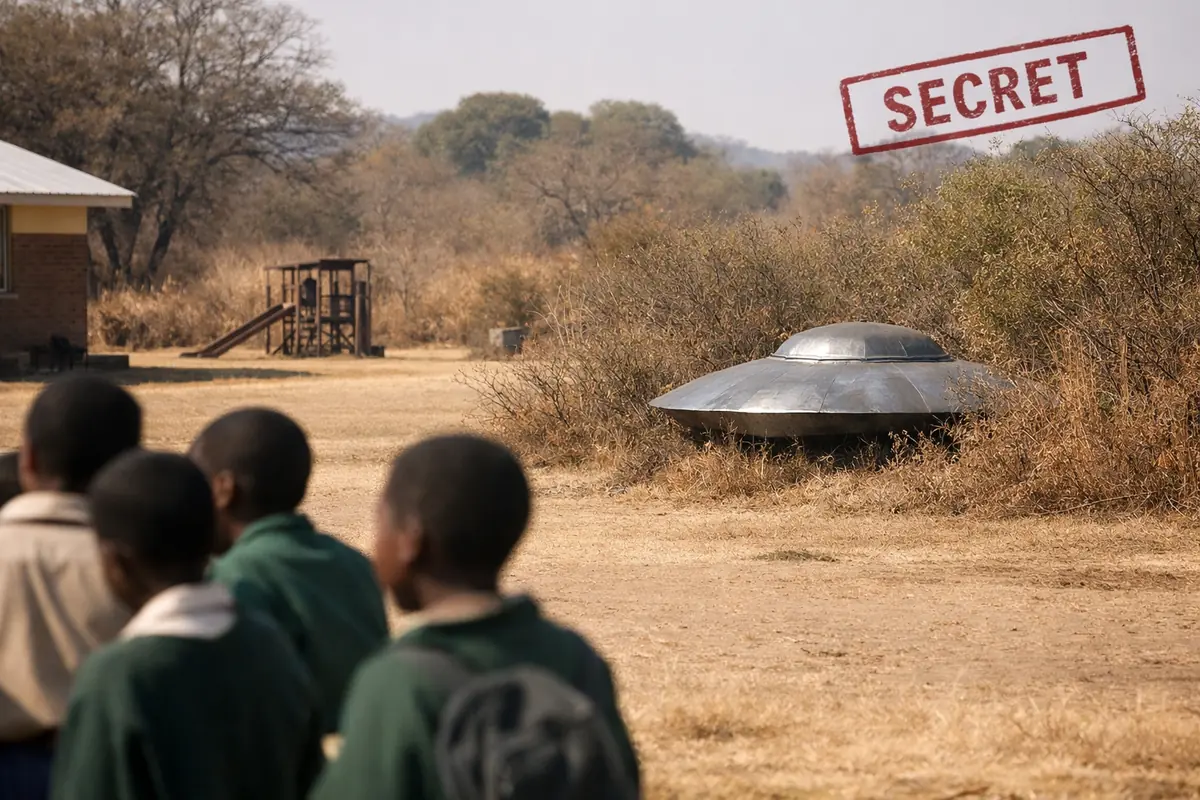
AI-generated illustration used to accompany this article.
Date
September 16, 1994
Location
Ariel School, Ruwa, Zimbabwe
Country
Zimbabwe
Category
School sighting
Status
Unresolved
Credibility
77/100
Notoriety
85/100
Coordinates
17.890° S · 31.245° E
Reading note
Why this file still matters
Ariel School became a global reference because dozens of children described the same playground disturbance within hours of it happening.
Timeline anchors
03
Distinct hypotheses
03
Sources used
03
Long summary
Narrative
A structured reading of the file, attentive to context, witnesses and the public circulation of the case.
The Ariel School case unfolded during a school break, which gives it a very different tone from most classic UFO files. Children reported seeing an object on or near the ground by the brush beyond the playground, along with one or more figures close to it. The account spread immediately because so many pupils were present and because the interruption came in the middle of an otherwise ordinary school day.
The file owes much of its force to timing. Drawings were made soon after the event, and interviews were conducted before the memory had much time to settle into a later legend. Those records show both overlap and variation, which is exactly why the case remains so difficult: the children did not tell one perfectly uniform story, yet a recognizable core persists across the testimony.
Ariel later acquired worldwide attention through follow-up interviews, especially those associated with John Mack, and through the adult recollections of some witnesses. It remains a powerful but delicate case, suspended between lived experience, childhood memory and the limits of interpretation. Its importance lies not in certainty, but in the persistence of the event across time.
Timeline
Sequence of events
The steps retained here prioritize historical markers and the turning points in the public narrative.
Children report a strange craft by the playground
On September 16, 1994, pupils at Ariel School describe a craft near the grounds.
Interviews are conducted soon after
The witness accounts are gathered while the memory is still fresh.
The case becomes a global school sighting reference
The number of children and the consistency of the interviews keep the file in circulation.
Hypotheses
Interpretive frameworks
The hypotheses remain distinct from the factual narrative. They organize possible readings without erasing the blind spots.
Likelihood medium
Misinterpreted terrestrial event
A normal event, seen through a child's perspective, may have acquired a more dramatic shape.
Likelihood medium
Collective memory shaped by interviews
The accounts may have converged as the story was retold and discussed.
Likelihood low
Genuine close encounter reported by children
The core of the school testimony still supports an unresolved event.
Sources
Documents and references
Historical sources, reports, archives and books used to structure this file.
The Ariel School Phenomenon
1994Video archives and investigative interviews
Early interview material collected from the Ariel School children while the event was still fresh.
John Mack interviews on the Ariel School case
1994Clinical and documentary research
Later educational and psychological discussion of the witness group and the interview record.
Ariel Phenomenon
2022Documentary
Reference summaries explaining why Ariel remains central in the history of school sightings.
Related cases
Related cases
Related cases connected by country, category or historical significance.
Westall 1966
April 6, 1966 · Australia
Westall remains Australia's best known school sighting because so many witnesses carried the same memory forward.

Valensole 1965
July 1, 1965 · France
Valensole became a French classic because an early-morning farm report stayed simple, stable and hard to dismiss outright.