Case file
Valensole 1965
July 1, 1965 · Valensole Plateau, Alpes-de-Haute-Provence
On July 1, 1965, farmer Maurice Masse said he saw a landed craft and two small figures in his lavender field before a rapid departure. The traces reported on the ground and the long-term consistency of his account anchored the case in the French close-encounter record.
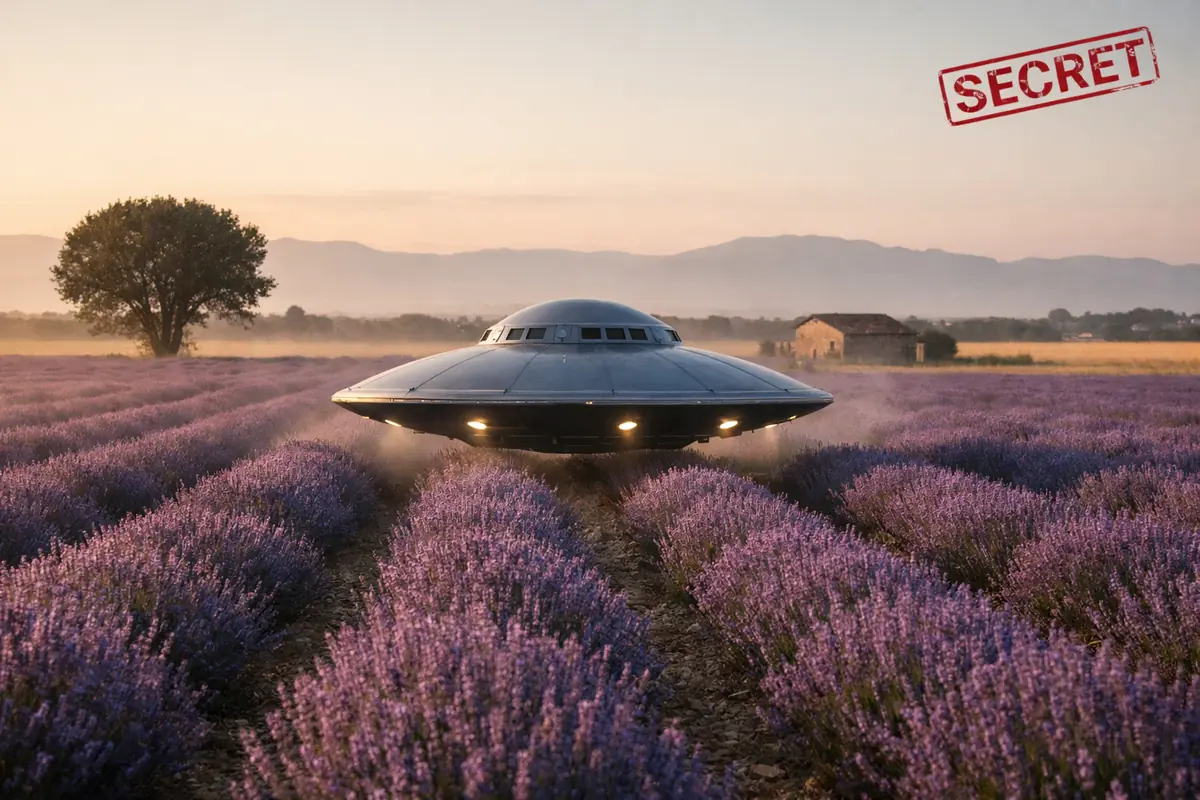
AI-generated illustration used to accompany this article.
Date
July 1, 1965
Location
Valensole Plateau, Alpes-de-Haute-Provence
Country
France
Category
Landing trace
Status
Unresolved
Credibility
79/100
Notoriety
84/100
Coordinates
43.838° N · 5.983° E
Reading note
Why this file still matters
Valensole became a French classic because an early-morning farm report stayed simple, stable and hard to dismiss outright.
Timeline anchors
03
Distinct hypotheses
03
Sources used
03
Long summary
Narrative
A structured reading of the file, attentive to context, witnesses and the public circulation of the case.
Valensole begins in one of the most ordinary settings in the French file: a farmer out early in his lavender field. Maurice Masse said he noticed an object on the ground and two small figures nearby before they returned to the craft and it left at speed. Nothing in the setting is exotic, and that plain rural context is part of what gave the case its enduring force.
The report was examined quickly. Traces were described in the field, the gendarmerie was informed, and the case moved into French research networks almost at once. In the years that followed, Valensole held its place less through sensational expansion than through the opposite quality: the witness remained broadly consistent and did not seem to remake the event every time he told it.
That is why Valensole still occupies a singular place in the French corpus. Its power does not come from spectacle or from a large number of witnesses, but from the sense of one episode that remained tied to the same core facts over a long period. It reads like a rural close encounter that never entirely unraveled.
Timeline
Sequence of events
The steps retained here prioritize historical markers and the turning points in the public narrative.
Morning sighting in the field
Maurice Masse reports a landed object and two small figures at dawn on July 1, 1965.
The gendarmerie documents the site
Ground traces and the first official observations are recorded very quickly.
The witness account remains stable
The story keeps the same basic structure in later retellings and studies.
Hypotheses
Interpretive frameworks
The hypotheses remain distinct from the factual narrative. They organize possible readings without erasing the blind spots.
Likelihood medium
Local hoax
Some readers see the case as a staged or embellished rural story.
Likelihood medium
Misidentified terrestrial craft
A human-made device may have been mistaken for something extraordinary.
Likelihood low
Unresolved close encounter
The witness consistency and the reported traces keep the case open.
Sources
Documents and references
Historical sources, reports, archives and books used to structure this file.
Dossier Valensole
1978GEPAN / CNES
French case file documenting the first reports, the local response and the early trace descriptions.
Les Apparitions d'Humanoïdes
1979Book by Michel Figuet and Jean-Louis Ruchon
Humanoid-encounter reference placing Valensole within the wider close-encounter literature.
Enquête sur le cas de Valensole
1966Lumières Dans La Nuit
Later investigative summary focused on the field traces and the witness chronology across retellings.
Related cases
Related cases
Related cases connected by country, category or historical significance.
Socorro / Lonnie Zamora
April 24, 1964 · United States
Socorro endured because a police officer's close-range report was followed almost immediately by checks on the ground.
Westall 1966
April 6, 1966 · Australia
Westall remains Australia's best known school sighting because so many witnesses carried the same memory forward.
Trans-en-Provence Case
January 8, 1981 · France
Trans-en-Provence became a major French case because a very short sighting generated a long laboratory trail.