Case file
Cussac
August 29, 1967 · Cussac, Cantal
On the morning of August 29, 1967, two children watching cattle near Cussac reported four small dark beings around a bright sphere, followed by a rapid departure. The case became a French landmark because the early testimony, gendarmerie attention, ufological inquiry, GEPAN review and skeptical criticism never fully settle into one reading.
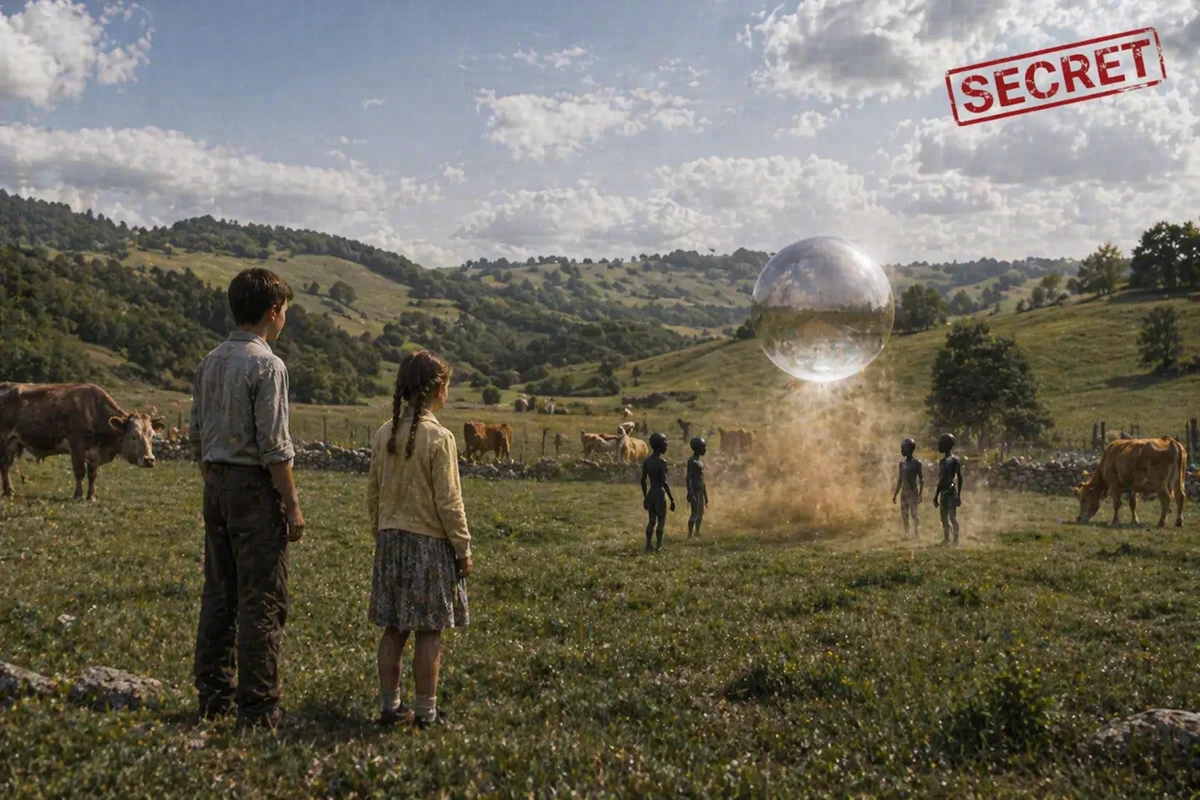
AI-generated illustration used to accompany this article.
Date
August 29, 1967
Location
Cussac, Cantal
Country
France
Category
Close encounter
Status
Unresolved
Credibility
78/100
Notoriety
88/100
Coordinates
45.050° N · 2.935° E
Reading note
Why this file still matters
Cussac is strong because the core report is early, compact and carried by two identified children. It is fragile because later investigations refined, challenged and sometimes shifted the details. The case has to be read as a witness-history file as much as a sighting file.
Timeline anchors
03
Distinct hypotheses
03
Sources used
03
Long summary
Narrative
A structured reading of the file, attentive to context, witnesses and the public circulation of the case.
The case begins in a rural setting near the village of Cussac, in the Cantal. François Delpeuch, thirteen and a half, and his nine-year-old sister Anne-Marie were watching cattle when they noticed several dark silhouettes near a bright object. In early and later accounts the figures are small, dark or black-clad, and the object is described as a luminous sphere or ball.
The children said the figures moved back toward the object and disappeared into it or near it before the object rose and departed. The exact order of movements, the number of figures seen in motion and some peripheral details vary from one reconstruction to another. The stable core is narrower: two children, a brief close-range scene, small dark beings, a brilliant object and a rapid departure.
Other details gave the case weight but also complexity. A whistling sound and a sulphur-like odor appear in the dossier, with some later discussion of who noticed what and when. Those details matter because they helped make Cussac famous, yet they should not be treated as having the same evidential status as the children's initial visual account.
The file was shaped very quickly by family reporting, gendarmerie attention, local press and specialist ufological inquiry. That early circulation is valuable because it brings the event close to the date of observation. It also means that the public case was formed through layers of language, summaries and expectations, not through a single neutral transcript.
GEPAN's later review gave the case an institutional afterlife. Supporters saw in the review a reason to take the children seriously; critics saw in the same file a record of evolving statements, leading questions and possible misperception. The most structured skeptical reading has often pointed toward a helicopter or another terrestrial stimulus, but that reading has never erased Cussac from the French canon. Its importance lies in the unresolved tension between a striking testimony and the documentary instability of every later reconstruction.
Timeline
Sequence of events
The steps retained here prioritize historical markers and the turning points in the public narrative.
Observation near Cussac
François and Anne-Marie Delpeuch report several small dark beings near a bright object while watching cattle near the village.
Local reporting and early circulation
The family, gendarmerie and press quickly enter the file, fixing the case in public memory soon after the alleged event.
GEPA, GEPAN and skeptical reviews
Ufological investigators, then GEPAN, then later critics revisit the case, debating consistency, context and possible terrestrial explanations.
Hypotheses
Interpretive frameworks
The hypotheses remain distinct from the factual narrative. They organize possible readings without erasing the blind spots.
Likelihood medium
Misidentification of a helicopter or terrestrial event
This reading stresses the later detail shifts, the difficulty of reconstructing duration and the possibility that an ordinary stimulus became extraordinary under stress. It remains debated because it does not reproduce every reported element with equal ease.
Likelihood medium
Sincere testimony consolidated by later layers
The children may have reported a disturbing event sincerely, while family memory, press language and investigator questioning later stabilized or altered parts of the story.
Likelihood low
A genuinely unidentified close encounter
The strongest pro-case reading keeps the object and occupants as unresolved. It rests on the early testimony and the seriousness of later inquiry, but depends on old narrative material rather than decisive physical evidence.
Sources
Documents and references
Historical sources, reports, archives and books used to structure this file.
First press report in La Montagne
1967La Montagne / UFOS at Close Sight archive
Useful for checking the first public version of the story against later, more elaborate reconstructions.
GEPA Mesnard-Pavy report
1968GEPA / Phénomènes Spatiaux
Early ufological investigation that fixed many of the details later repeated in French case literature.
Critical Cussac chapter
2007Cercle zététique / Ovni du CNES
Skeptical review useful for tracking documentary divergences, late details and the terrestrial-misperception hypothesis.
Related cases
Cases to connect
Neighbouring affairs by country, case type, or role in the public debate.

Valensole 1965
July 1, 1965 · France
Valensole is the nearest French comparison point, with a rural witness, a landed object and small figures reported in a quickly publicized case.
Trans-en-Provence
January 8, 1981 · France
Another French landmark in which an official technical inquiry extended a short, local sighting into a lasting case file.
Quarouble 1954
September 10, 1954 · France
Quarouble gives Cussac an earlier French comparison, but in a more heavily media-driven and later embellished 1954 context.