Case file
Quarouble
September 10, 1954 · Quarouble, near Valenciennes
On the night of September 10, 1954, metalworker Marius Dewilde, living near a level crossing, reported a dark object beside the railway and two small beings returning to it after a beam of light immobilized him. The case became one of the French symbols of the 1954 wave, but its later history demands a strict separation between the initial report and later additions.
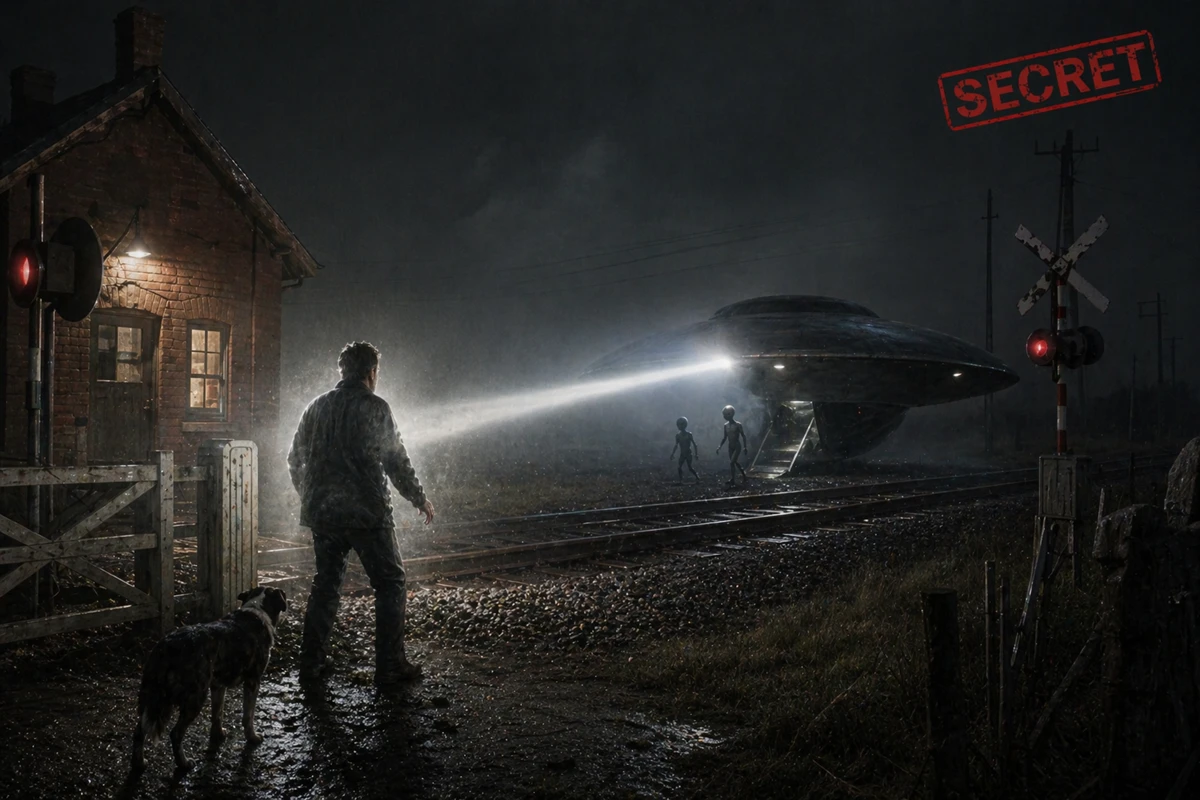
AI-generated illustration used to accompany this article.
Date
September 10, 1954
Location
Quarouble, Nord
Country
France
Category
Close encounter
Status
Contested
Credibility
64/100
Notoriety
89/100
Coordinates
50.386° N · 3.624° E
Reading note
Why this file still matters
Quarouble belongs in any French chronology because it sits at the center of the 1954 media wave. Its weakness is the same point: a strong initial report was later surrounded by press excitement, ufological retellings and additional claims that do not all deserve the same evidential weight.
Timeline anchors
03
Distinct hypotheses
03
Sources used
03
Long summary
Narrative
A structured reading of the file, attentive to context, witnesses and the public circulation of the case.
On September 10, 1954, around 10:30 p.m., Marius Dewilde was at his small home near a level crossing in Quarouble, close to Valenciennes. In the story that quickly reached newspapers, his dog began barking, he went outside with a lamp, and he noticed a dark mass near the railway line. At first the scene could be read as ordinary, perhaps a cart, children or smugglers depending on the version, before two small silhouettes entered the account.
The central report is compact: two small beings, a dark craft or mass near the tracks, and a light beam that dazzled or immobilized Dewilde as he tried to approach. The beings reportedly returned to the object, which then rose or departed. Those elements made the case memorable because they combine a landed object, occupants, a paralysis motif and a concrete railway setting.
Contemporary and later accounts also mention physical traces. Marks were reportedly found on railway sleepers, ballast stones were discussed, and the air police and local authorities were said to have taken interest in the scene. These details explain why Quarouble became more than a simple newspaper anecdote. They do not, by themselves, establish what Dewilde saw, because the interpretation and preservation of the trace material vary across sources.
The 1954 context matters. France was in the middle of a major wave of flying-saucer reports, including many landing and occupant stories. Newspapers readily used the language of Martians and saucers, and Quarouble became one of the most vivid scenes in that public imagination. Aimé Michel, Jacques Vallée and many later compilations kept the name alive, turning a local report into a national reference.
The later history forces caution. Dewilde went on to tell other stories, including a second encounter in October 1954, which many commentators have treated as far less credible. Some retellings add or reshape details, and the witness's later public image became part of the case itself. A rigorous dossier therefore cannot treat every layer of Quarouble as equal. The September 10 report is historically important; the later claims belong to the legend's growth, not to the same evidential core.
Timeline
Sequence of events
The steps retained here prioritize historical markers and the turning points in the public narrative.
Marius Dewilde goes outside
Alerted by his dog, Dewilde reports a dark mass near the railway, two small figures and a beam of light that immobilizes him.
Local inquiry and alleged traces
Authorities and air-police involvement are reported, with marks on railway sleepers and ballast discussed in contemporary and later accounts.
Media afterlife and later claims
The case becomes a classic of the French 1954 wave, then accumulates later episodes that are treated much more skeptically.
Hypotheses
Interpretive frameworks
The hypotheses remain distinct from the factual narrative. They organize possible readings without erasing the blind spots.
Likelihood medium
Sincere report around a misread terrestrial episode
Dewilde may have experienced a confusing night event near the railway and interpreted it through the charged atmosphere of 1954. This allows sincerity without accepting the full extraordinary narrative.
Likelihood high
Case amplified by the 1954 wave
Press expectations, saucer language and later ufological retellings may have turned a local testimony into a classic. The later additions strengthen the need for caution.
Likelihood low
A genuinely unidentified close encounter
The strongest pro-case reading keeps the beings, the craft and the reported marks as signs of a real anomaly. Its weakness is the uneven documentation and the witness's later embellished claims.
Sources
Documents and references
Historical sources, reports, archives and books used to structure this file.
Quarouble, September 10, 1954 case file
1954UFOS at Close Sight / press archive
Useful for comparing press versions, ufological summaries and the recurring claims about marks on the railway.
Marius Dewilde
1954Encyclopedic notice and bibliography
Reference point for separating the first report, the media attention and the witness's later additional claims.
Flying Saucers and the Straight-Line Mystery
1958Aimé Michel
A historical ufological landmark for understanding why Quarouble was folded into the classic narrative of the 1954 French wave.
Related cases
Cases to connect
Neighbouring affairs by country, case type, or role in the public debate.
Cussac 1967
August 29, 1967 · France
Cussac offers a later French comparison, again with small beings and a near-ground object, but in a different documentary context.

Valensole 1965
July 1, 1965 · France
Another French classic in which a single witness, small figures and a landed object shaped the long-term memory of the file.
Socorro / Lonnie Zamora
April 24, 1964 · United States
Socorro is a better documented international comparison around a landed object, occupants and police investigation.