Case file
Falcon Lake Incident
May 20, 1967 · Falcon Lake, Manitoba
On May 20, 1967, prospector Stefan Michalak said two luminous objects descended near him in Manitoba and that he was struck by a burst of intense heat as one left. RCMP and federal follow-up, medical attention and the Department of National Defence's unresolved classification gave the file unusual staying power.
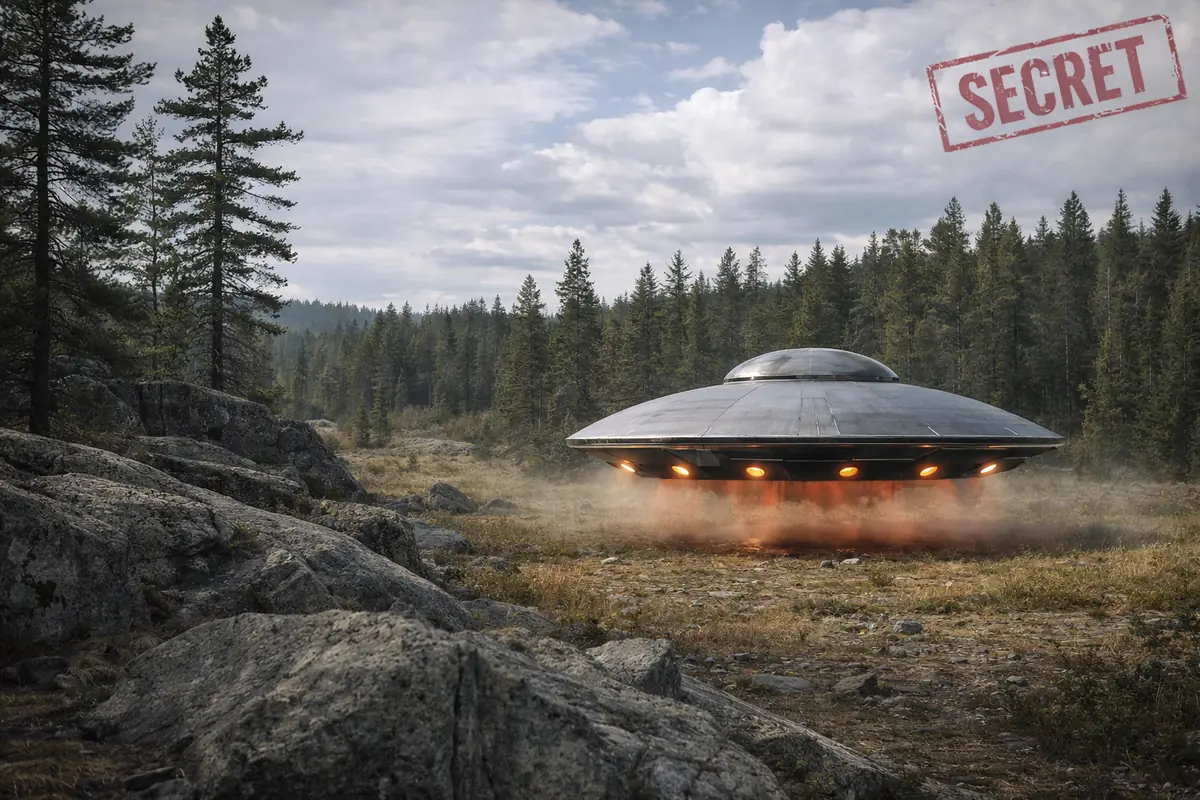
AI-generated illustration used to accompany this article.
Date
May 20, 1967
Location
Falcon Lake, Manitoba
Country
Canada
Category
Close encounter
Status
Unresolved
Credibility
76/100
Notoriety
89/100
Coordinates
49.691° N · 95.318° W
Reading note
Why this file still matters
Falcon Lake remains Canada's most famous physical close encounter because the witness's story was followed by illness, marks and federal paperwork.
Timeline anchors
03
Distinct hypotheses
03
Sources used
03
Long summary
Narrative
A structured reading of the file, attentive to context, witnesses and the public circulation of the case.
On May 20, 1967, Stefan Michalak was prospecting near Falcon Lake when, according to the archival record, he saw two luminous objects descend. One moved off; the other remained close, changed appearance and came to resemble a metallic craft. Michalak approached it and later said he was struck by a blast of very hot gas or air as it rose away.
In the hours that followed, he became ill. Official retrospectives refer to nausea, vomiting, marks on his chest and a medical controversy that lasted well beyond the initial incident. The RCMP and Royal Canadian Air Force moved in quickly, federal agencies became involved, and later archival reviews also mention a circular depression observed at the site. Falcon Lake did not remain just a witness statement; it became a documented Canadian file with administrative and medical layers.
That is what gives the case its singular place. The event is still debated, but the record is unusually dense: testimony, police response, medical attention and long-term official interest all remain attached to the same narrative. The Department of National Defence's unresolved classification helped keep Falcon Lake alive as more than a local legend.
Timeline
Sequence of events
The steps retained here prioritize historical markers and the turning points in the public narrative.
A craft is reported near the rocks
Michalak describes a disc-like object settling near him on May 20, 1967.
The witness suffers burns
A hot burst or exhaust leaves marks that draw medical attention.
The case becomes a Canadian benchmark
Formal follow-up and later studies keep Falcon Lake in circulation.
Hypotheses
Interpretive frameworks
The hypotheses remain distinct from the factual narrative. They organize possible readings without erasing the blind spots.
Likelihood medium
Unusual terrestrial device or experiment
A human-made object may have produced the burns and the sighting.
Likelihood medium
Misread natural or industrial event
Heat, terrain and stress may have transformed a brief event into a close encounter.
Likelihood low
Physical close encounter
The injury and the witness chronology keep the case open as a true anomaly.
Sources
Documents and references
Historical sources, reports, archives and books used to structure this file.
UFOs at LAC: The Falcon Lake incident, part 1
2019Library and Archives Canada
Original Canadian police and witness material preserving the immediate Falcon Lake chronology.
Open sourceUFOs at LAC: The Falcon Lake incident, part 2
2019Library and Archives Canada
Medical and investigative follow-up focused on the reported burn pattern and later illness.
Open sourceStefan Michalak - Report of Unidentified Flying Object, Falcon Beach, Manitoba - 20 MAY 67
1967Royal Canadian Mounted Police
Later Canadian summaries explaining why Falcon Lake became one of the country's best known files.
Open sourceRelated cases
Related cases
Related cases connected by country, category or historical significance.

Valensole 1965
July 1, 1965 · France
Valensole became a French classic because an early-morning farm report stayed simple, stable and hard to dismiss outright.
Socorro / Lonnie Zamora
April 24, 1964 · United States
Socorro endured because a police officer's close-range report was followed almost immediately by checks on the ground.
Shag Harbour Incident
October 4, 1967 · Canada
Shag Harbour is unusual because witnesses first thought they were reporting an aircraft crash, not a UFO.