Case file
Phoenix Lights
March 13, 1997 · Phoenix, Arizona
On March 13, 1997, witnesses across Arizona reported a large formation moving silently overhead, and later lights appeared above the Phoenix area. Debate has long centered on whether the evening combined separate events, with the later lights often linked to military flares.
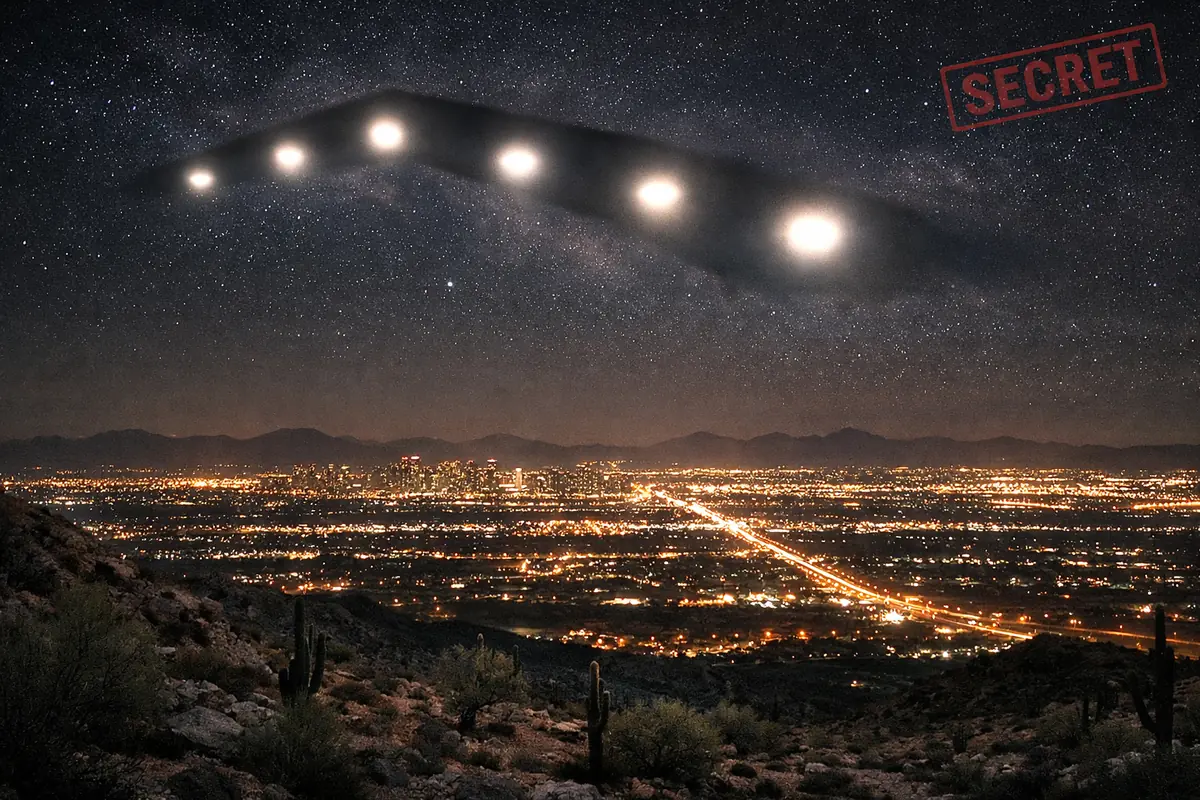
AI-generated illustration used to accompany this article.
Date
March 13, 1997
Location
Phoenix, Arizona
Country
United States
Category
Mass sighting
Status
Partially explained
Credibility
73/100
Notoriety
95/100
Coordinates
33.448° N · 112.074° W
Reading note
Why this file still matters
Phoenix Lights lasted because one Arizona night seems to contain both a statewide transit and the famous stationary lights over the city.
Timeline anchors
03
Distinct hypotheses
03
Sources used
03
Long summary
Narrative
A structured reading of the file, attentive to context, witnesses and the public circulation of the case.
Phoenix Lights is not one scene but at least two linked in public memory. The first part concerns a slow, silent passage seen across a wide stretch of Arizona, described by some witnesses as a formation and by others as a single immense structure. The second part, filmed later over the Phoenix area, produced the stationary or slow-moving lights that became the iconic images of the case.
That distinction matters because the Air National Guard flare explanation fits a large part of the later recordings, especially the most familiar visual material. It does not automatically dissolve the earlier reports from across the state, which were made at different times and in a different narrative register. Much of the debate since 1997 has come from the tendency to fold those phases into one seamless event.
Phoenix remained so powerful because it joined mass witness memory, amateur video and the idea of an object of extraordinary scale. Even for people who accept a flare explanation for part of the evening, the case survives as a lesson in how a modern sighting can become a public image before it becomes a settled file.
Timeline
Sequence of events
The steps retained here prioritize historical markers and the turning points in the public narrative.
A formation moves over Arizona
Thousands of witnesses report lights crossing the state on March 13, 1997.
Stationary lights are seen over Phoenix
Later lights over the city help fix the event in public memory.
The case becomes a mass-sighting landmark
Media coverage and witness density make the file one of the most famous American UFO cases.
Hypotheses
Interpretive frameworks
The hypotheses remain distinct from the factual narrative. They organize possible readings without erasing the blind spots.
Likelihood high
Military flares or aircraft activity
The lights may have come from terrestrial training or aviation activity.
Likelihood medium
Multiple events merged into one night
The state-wide memory may combine distinct sightings reported separately.
Likelihood low
Large unresolved aerial event
The scale of the witness set still keeps an unexplained core in play.
Sources
Documents and references
Historical sources, reports, archives and books used to structure this file.
The Phoenix Lights
2004Book by Lynne D. Kitei
Television and witness coverage that fixed the Phoenix Lights in public memory from the start.
Statements from the Arizona National Guard
1997Official documents and communications
Arizona broadcasts and follow-up interviews documenting the different phases reported that night.
Phoenix Lights media archive
1997Arizona local television
Later case histories comparing Phoenix with other modern mass sightings and flare debates.
Related cases
Related cases
Related cases connected by country, category or historical significance.
Belgian UFO Wave
November 29, 1989 · Belgium
The Belgian wave is remembered as the moment triangular sightings became a national file rather than a string of local stories.
Japan Airlines Flight 1628
November 17, 1986 · United States
JAL 1628 stands out because a cargo crew described a long aerial encounter inside a fully documented civil-aviation setting.
Shag Harbour Incident
October 4, 1967 · Canada
Shag Harbour is unusual because witnesses first thought they were reporting an aircraft crash, not a UFO.