Case file
Belgian UFO Wave
November 29, 1989 · Belgium
From late 1989 to spring 1990, Belgium accumulated hundreds of reports describing dark triangular objects, followed by the celebrated F-16 interception night of March 30-31, 1990. The wave remains a benchmark because civilian testimony, police work and military involvement all entered the record.
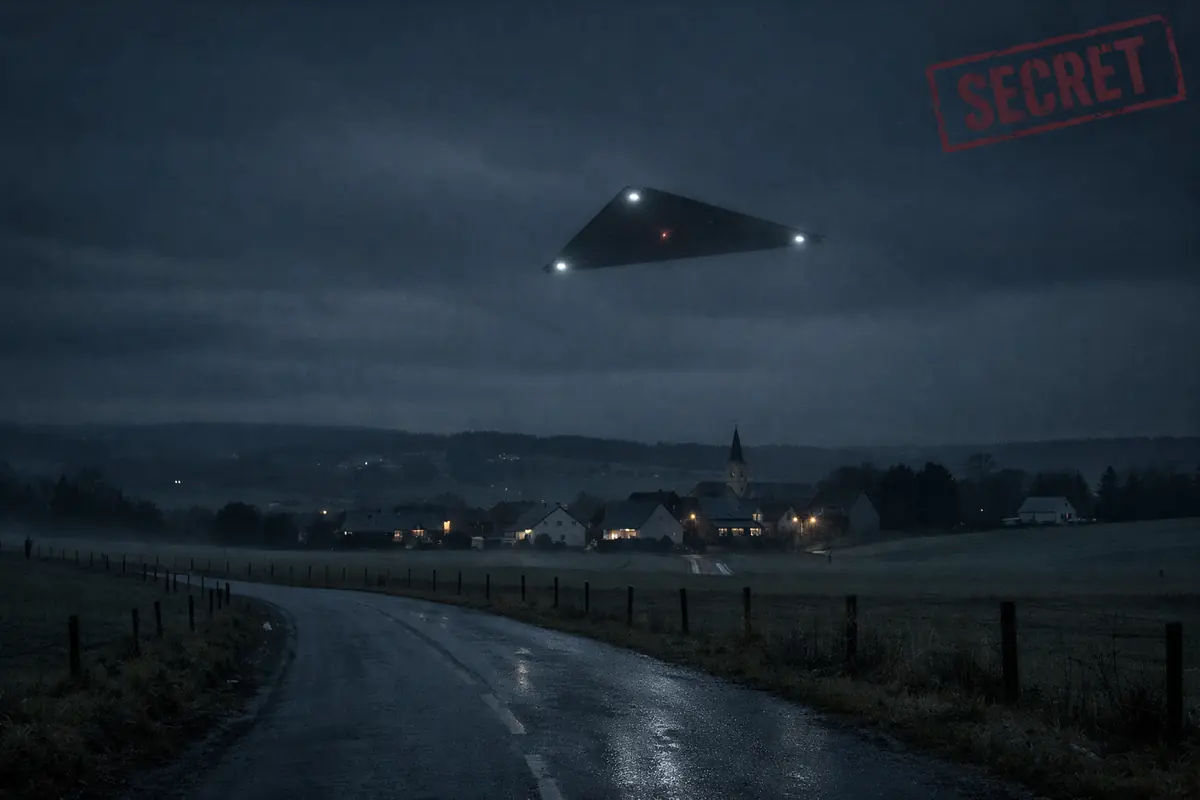
AI-generated illustration used to accompany this article.
Date
November 29, 1989
Location
Belgium
Country
Belgium
Category
Mass sighting
Status
Partially explained
Credibility
75/100
Notoriety
89/100
Coordinates
50.629° N · 6.031° E
Reading note
Why this file still matters
The Belgian wave is remembered as the moment triangular sightings became a national file rather than a string of local stories.
Timeline anchors
03
Distinct hypotheses
03
Sources used
03
Long summary
Narrative
A structured reading of the file, attentive to context, witnesses and the public circulation of the case.
The Belgian wave unfolded over many months and many places, which is one reason it never collapsed into a single anecdote. From the autumn of 1989 onward, witnesses described dark triangular structures carrying fixed lights and moving slowly, often silently, over roads, towns and open country. SOBEPS gathered reports while the Belgian authorities adopted a public posture that was unusually open by the standards of the period.
The night of March 30-31, 1990 became the pivotal episode. After multiple alerts, F-16s were sent up and radar recordings fed the idea that something outside ordinary air traffic might have been involved. Even so, the military data did not produce a simple proof; it reinforced the impression of a serious wave that resisted quick closure rather than ending the argument.
That balance between documentary density and explanatory limits is exactly what makes the Belgian wave important. It remains a case study in how a country can document a prolonged series of sightings, involve police and military institutions, and still emerge without a conclusion accepted by everyone.
Timeline
Sequence of events
The steps retained here prioritize historical markers and the turning points in the public narrative.
Triangular sightings spread across the country
From late 1989, many witnesses report silent triangular craft over Belgium.
F-16 intercept attempts are launched
Belgian air defense engages in the best known interception night of the wave.
The wave becomes a national reference
Police, civilian and military accounts together fix the case in public memory.
Hypotheses
Interpretive frameworks
The hypotheses remain distinct from the factual narrative. They organize possible readings without erasing the blind spots.
Likelihood medium
Merging of different sightings
The wave may combine separate events that were later grouped together.
Likelihood medium
Conventional aircraft or atmospheric confusion
Some reports may have involved earthly lights or aircraft seen under difficult conditions.
Likelihood low
Genuine national-scale anomaly
The density and persistence of the reports still support an unresolved reading.
Sources
Documents and references
Historical sources, reports, archives and books used to structure this file.
UFO Wave over Belgium
1991SOBEPS
Witness and police collections that show how the wave was documented across the country.
Belgian Air Component reports
1990Belgian Air Force
Air Force material from the famous F-16 interception night and the radar discussion around it.
The Belgian UFO Wave of 1989-1990
1994European UAP studies
Later syntheses explaining why the Belgian wave became a European reference case.
Related cases
Related cases
Related cases connected by country, category or historical significance.
Washington D.C. Radar-Visual Wave
July 19, 1952 · United States
Washington 1952 put UFOs over the US capital and forced the Air Force to answer in public.
Rendlesham Forest
December 26, 1980 · United Kingdom
Rendlesham stayed alive because it was not one sighting but a chain of military nights, memos and competing explanations.
Phoenix Lights
March 13, 1997 · United States
Phoenix Lights lasted because one Arizona night seems to contain both a statewide transit and the famous stationary lights over the city.