Case file
Rendlesham Forest
December 26, 1980 · Rendlesham Forest, Suffolk
Between December 26 and 28, 1980, US personnel near Bentwaters and Woodbridge reported lights in Rendlesham Forest, a possible object among the trees and traces on the ground. Charles Halt's memo and audio recording gave the case an afterlife far beyond Suffolk.
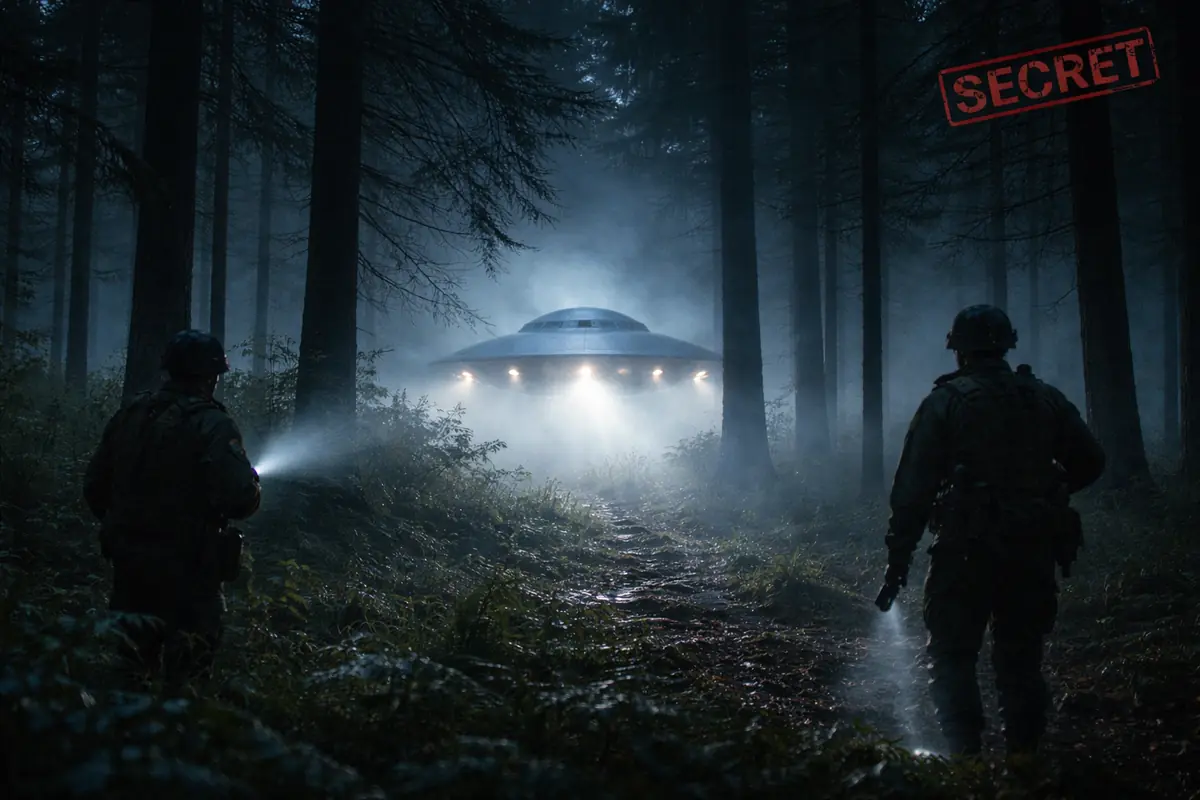
AI-generated illustration used to accompany this article.
Date
December 26, 1980
Location
Rendlesham Forest, Suffolk
Country
United Kingdom
Category
Military observation
Status
Contested
Credibility
76/100
Notoriety
92/100
Coordinates
52.094° N · 1.443° E
Reading note
Why this file still matters
Rendlesham stayed alive because it was not one sighting but a chain of military nights, memos and competing explanations.
Timeline anchors
03
Distinct hypotheses
03
Sources used
03
Long summary
Narrative
A structured reading of the file, attentive to context, witnesses and the public circulation of the case.
Rendlesham does not reduce to a single dramatic night. A first patrol went into the forest after lights were seen near the trees, and the accounts from that outing introduced the central motifs of the case: a possible object in the woods, close-range observation and marks on the ground. From the start, the file was sequential rather than simple, made up of perceptions followed immediately by discussion and reinterpretation.
Two nights later, Deputy Base Commander Charles Halt led another outing that produced the memo and audio recording most often associated with the case. Those documents pulled Rendlesham out of the local setting and into the broader public record. Once the memo circulated, the incident ceased to be only a base story and became one of the best known military UFO cases in Europe.
Later readings have moved between prosaic explanations, especially the Orfordness lighthouse combined with nighttime misperception, and the claim that an irreducible core remains even after those corrections. That unresolved tension is precisely why Rendlesham lasts. The case sits where military culture, witness testimony and archival uncertainty meet, and none of those layers has ever fully displaced the others.
Timeline
Sequence of events
The steps retained here prioritize historical markers and the turning points in the public narrative.
Lights in the forest
Personnel report moving lights among the trees on the first nights of the incident.
Ground traces are examined
An object on or near the ground prompts checks and further observations.
The case enters British UFO history
Statements and later summaries give the forest sighting a lasting reputation.
Hypotheses
Interpretive frameworks
The hypotheses remain distinct from the factual narrative. They organize possible readings without erasing the blind spots.
Likelihood medium
Military activity or terrestrial lights
Exercises, flares or other base-related activity may explain part of the episode.
Likelihood medium
Witnesses shaping a shared memory
The file may reflect overlapping impressions later merged into one larger story.
Likelihood low
Unresolved nocturnal encounter
The repeated sightings and military setting keep the case open.
Sources
Documents and references
Historical sources, reports, archives and books used to structure this file.
The Halt Memorandum
1981U.S. Air Force records
US Air Force personnel accounts collected after the forest nights and used to reconstruct the sequence.
You Can't Tell the People
2000Book by Georgina Bruni
British summaries and later studies reviewing the traces, the statements and the competing lighthouse explanation.
Skeptical analyses of the Rendlesham events
2001British specialist press
Reference works showing how Rendlesham became one of the central UK UFO cases.
Related cases
Related cases
Related cases connected by country, category or historical significance.
Tehran 1976
September 19, 1976 · Iran
Tehran 1976 became a military classic because civilian reports escalated into fighter intercepts and a diplomatic record.
Belgian UFO Wave
November 29, 1989 · Belgium
The Belgian wave is remembered as the moment triangular sightings became a national file rather than a string of local stories.
Mantell Incident
January 7, 1948 · United States
The Mantell case fused the early saucer wave with a fatal military pursuit, which is why it never faded from the record.