Case file
Washington D.C. Radar-Visual Wave
July 19, 1952 · Washington D.C.
Over two July weekends in 1952, radar operators and visual witnesses around Washington reported unusual targets while interceptors were sent into the night sky. The official explanation invoked temperature inversions, but the scale of the response made the sightings a landmark in the relationship between UFOs, air defense and public communication.
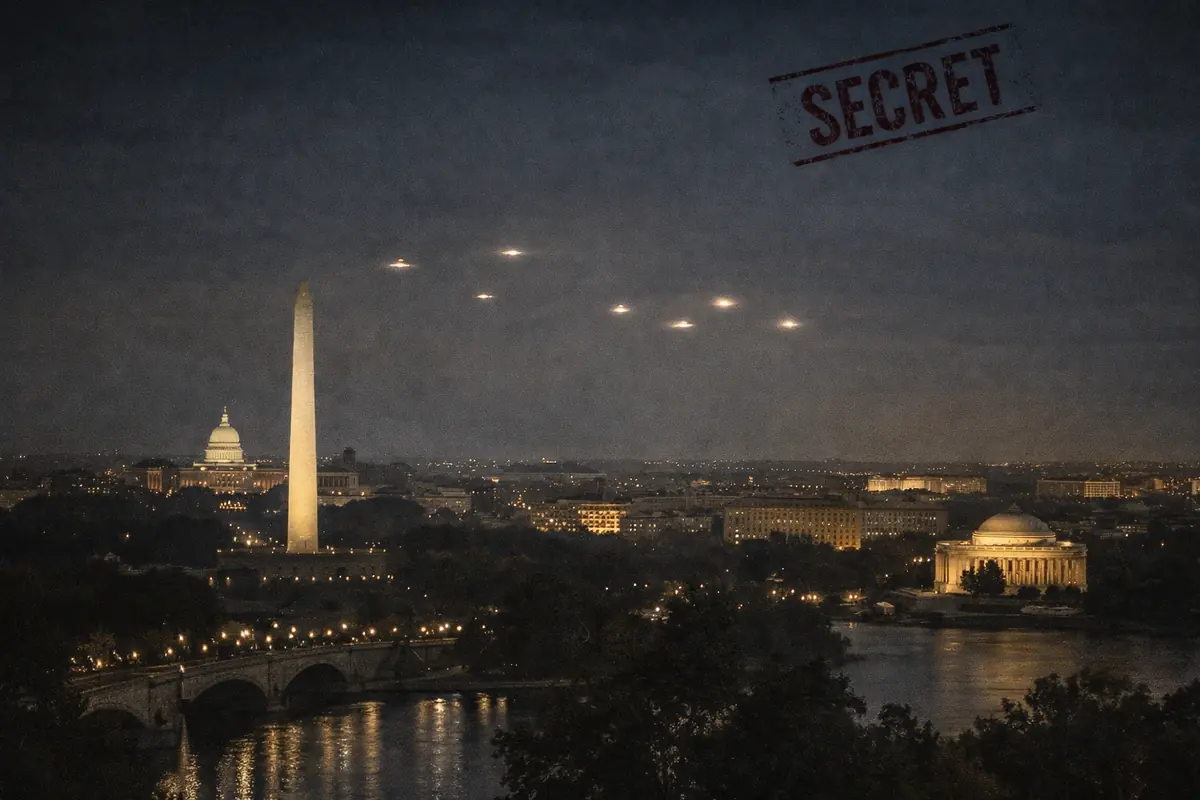
AI-generated illustration used to accompany this article.
Date
July 19, 1952
Location
Washington D.C.
Country
United States
Category
Radar visual
Status
Investigated
Credibility
74/100
Notoriety
91/100
Coordinates
38.907° N · 77.037° W
Reading note
Why this file still matters
Washington 1952 put UFOs over the US capital and forced the Air Force to answer in public.
Timeline anchors
03
Distinct hypotheses
03
Sources used
03
Long summary
Narrative
A structured reading of the file, attentive to context, witnesses and the public circulation of the case.
The Washington case is built around two nights, July 19 and July 26, 1952, when the American capital briefly became a UFO theater. Radar operators at National Airport and Andrews Air Force Base reported unusual plots, while observers on the ground and in the air described moving lights over the city. The incident immediately carried a weight that smaller local sightings did not: these reports were unfolding above the political center of the United States.
Interceptors were scrambled more than once, but no decisive interception followed. The Air Force eventually advanced temperature inversion as the main explanation for the radar effects, yet that answer never fully settled the matter because multiple stations, visual witnesses and military personnel were all part of the same file. The official response therefore became almost as important as the sightings themselves.
Washington 1952 matters because it shifted the subject from rumor and regional headlines into the language of national security. Once UFOs had to be discussed at a major Air Force press conference, they were no longer just odd stories from elsewhere. They had become a problem of institutional credibility.
Timeline
Sequence of events
The steps retained here prioritize historical markers and the turning points in the public narrative.
First radar and visual contacts
On July 19, unusual radar plots and lights over the city trigger an immediate response.
Interceptors are launched
Military aircraft are scrambled more than once, without a conclusive lock-on.
The Air Force holds a press conference
The official temperature-inversion explanation is presented in public, but the debate continues.
Hypotheses
Interpretive frameworks
The hypotheses remain distinct from the factual narrative. They organize possible readings without erasing the blind spots.
Likelihood high
Temperature inversion
Radar anomalies may have been caused or amplified by atmospheric inversions.
Likelihood medium
Mix of traffic and misreadings
Air traffic, lights and radar clutter may have been blended into one larger story.
Likelihood low
Unresolved radar visual incident
The overlap of radar, visuals and military response still leaves room for an unexplained core.
Sources
Documents and references
Historical sources, reports, archives and books used to structure this file.
Project Blue Book Special Report on Washington National Sightings
1952U.S. Air Force
Official report reconstructing the Washington radar-visual sequence and the Air Force's inversion argument.
The Report on Unidentified Flying Objects
1956Book by Edward J. Ruppelt
Blue Book documentation preserving the overlap between radar returns, visual reports and interceptions.
Capital Flying Saucers Cause Sensation
1952American press archives
Contemporary press coverage showing how the capital sightings became a national story almost overnight.
Related cases
Related cases
Related cases connected by country, category or historical significance.
Kenneth Arnold Sighting
June 24, 1947 · United States
Arnold's June 1947 report mattered because it gave the postwar world the phrase flying saucer.
Belgian UFO Wave
November 29, 1989 · Belgium
The Belgian wave is remembered as the moment triangular sightings became a national file rather than a string of local stories.
Phoenix Lights
March 13, 1997 · United States
Phoenix Lights lasted because one Arizona night seems to contain both a statewide transit and the famous stationary lights over the city.