Case file
Kenneth Arnold Sighting
June 24, 1947 · Mount Rainier sector, Washington State
Flying near Mount Rainier on June 24, 1947, Kenneth Arnold reported nine fast objects moving in formation. His comparison to a saucer skipping across water was repeated by the press, transforming one pilot's account into the shared vocabulary of the modern UFO era.
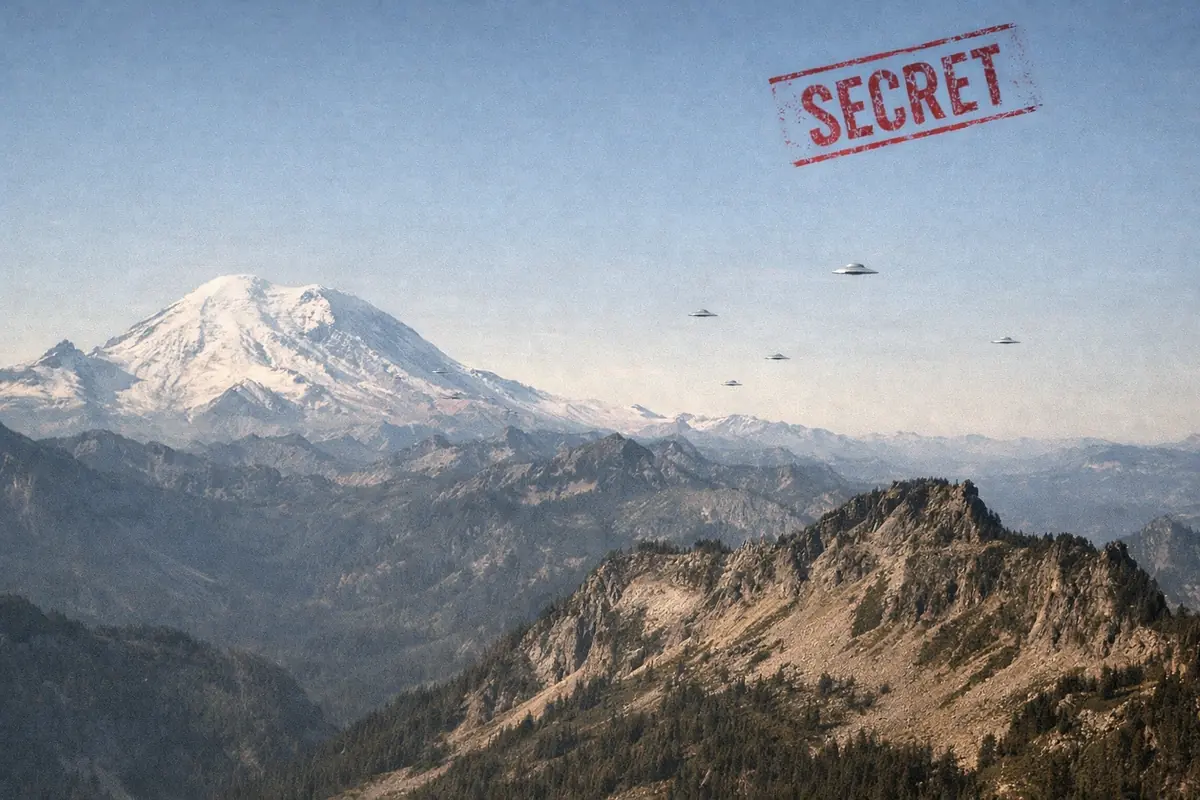
AI-generated illustration used to accompany this article.
Date
June 24, 1947
Location
Mount Rainier sector, Washington State
Country
United States
Category
Aircrew encounter
Status
Investigated
Credibility
72/100
Notoriety
94/100
Coordinates
46.852° N · 121.760° W
Reading note
Why this file still matters
Arnold's June 1947 report mattered because it gave the postwar world the phrase flying saucer.
Timeline anchors
03
Distinct hypotheses
03
Sources used
03
Long summary
Narrative
A structured reading of the file, attentive to context, witnesses and the public circulation of the case.
Kenneth Arnold was on a routine flight over Washington State when he noticed nine bright objects whose speed and movement struck him as extraordinary. What made the account travel so quickly was its pilot's precision: he described distance, alignment, heading and the way the surfaces caught the light with the vocabulary of someone used to judging an aircraft in motion.
The press then did the rest. Arnold's comparison concerned the way the objects moved, not their exact shape, but newspapers turned that phrase into a label. In only a few days, flying saucer ceased to be a description in one report and became a public category in its own right.
That shift is the real historical importance of the case. Arnold did not merely file an unusual sighting near Mount Rainier; he unintentionally supplied the term that would structure thousands of later accounts. The case matters because it marks the moment when scattered aerial mysteries acquired a common name.
Timeline
Sequence of events
The steps retained here prioritize historical markers and the turning points in the public narrative.
Routine flight near Mount Rainier
Arnold sees a formation of bright objects while crossing Washington State on June 24, 1947.
The flying saucer phrase spreads
Journalists seize on the motion comparison and turn it into a new public label.
The sighting becomes a reference case
The account is reprinted, debated and folded into the first wave of postwar UFO reporting.
Hypotheses
Interpretive frameworks
The hypotheses remain distinct from the factual narrative. They organize possible readings without erasing the blind spots.
Likelihood high
Conventional aircraft misjudged at distance
The objects may have been ordinary craft whose speed and shape were distorted by perspective.
Likelihood medium
Atmospheric or reflection-related phenomenon
Light and atmospheric conditions may have contributed to the unusual appearance.
Likelihood low
Genuinely anomalous aerial observation
The original description still reads, for some observers, like a real but unclassified event.
Sources
Documents and references
Historical sources, reports, archives and books used to structure this file.
The Coming of the Saucers
1952Book by Kenneth Arnold and Raymond Palmer
Arnold's own account, useful for the flight path, the visual description and the language he originally used.
Contemporary Press Dispatches on Kenneth Arnold
1947Associated Press Archives
Contemporary press dispatches showing how the phrase flying saucer moved from quotation to headline term.
The UFO Experience
1972Book by J. Allen Hynek
Later historical analysis placing the sighting at the opening of the modern UFO era.
Related cases
Related cases
Related cases connected by country, category or historical significance.
Roswell Incident
July 8, 1947 · United States
Roswell entered UFO history because the Army said 'flying disc' before reversing itself within hours.
Washington D.C. Radar-Visual Wave
July 19, 1952 · United States
Washington 1952 put UFOs over the US capital and forced the Air Force to answer in public.
Phoenix Lights
March 13, 1997 · United States
Phoenix Lights lasted because one Arizona night seems to contain both a statewide transit and the famous stationary lights over the city.