Case file
Lakenheath-Bentwaters
August 13-14, 1956 · RAF Bentwaters and RAF Lakenheath sector, East Anglia
Personnel at Bentwaters and Lakenheath reported a chain of events involving radar returns, lights seen from the ground and an interceptor episode that later accounts never fully reconciled. The case matters because the documentation is military, technical and internally inconsistent all at once.
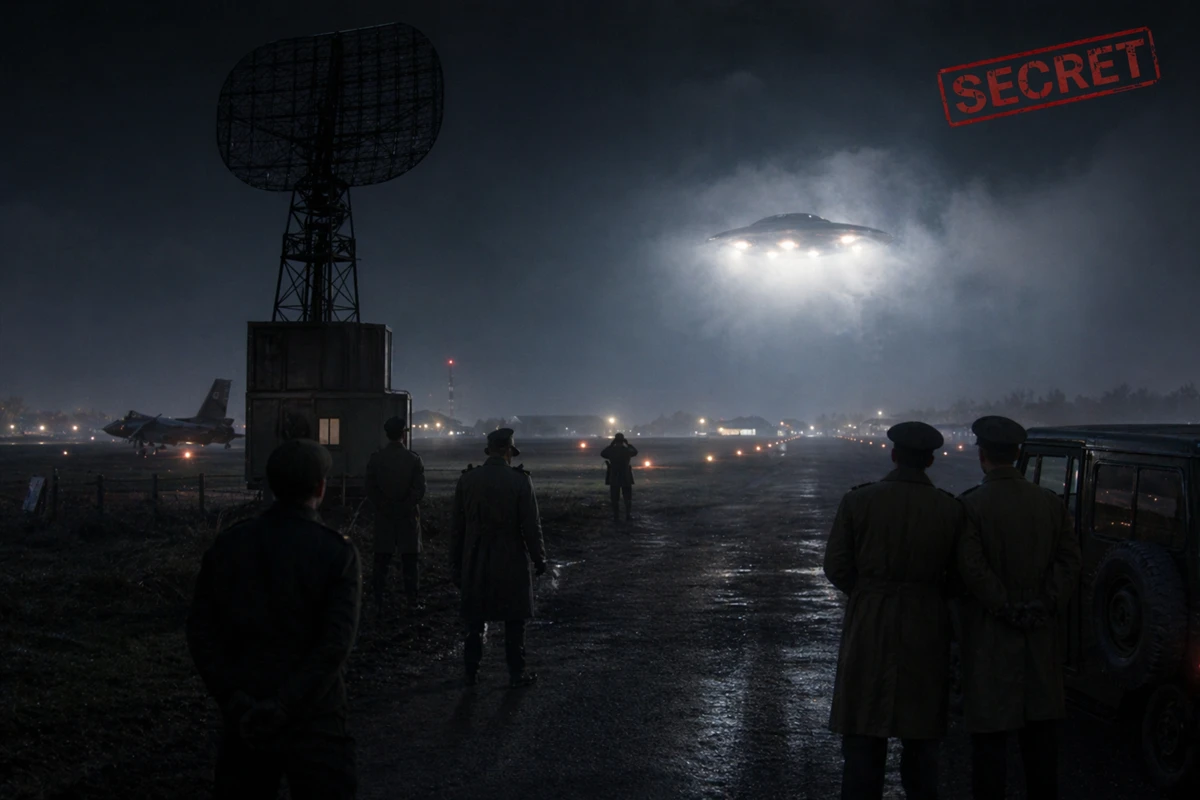
AI-generated illustration used to accompany this article.
Date
August 13-14, 1956
Location
Bentwaters and Lakenheath, East Anglia
Country
United Kingdom
Category
Military radar-visual case
Status
Contested
Credibility
82/100
Notoriety
88/100
Coordinates
52.268° N · 0.998° E
Reading note
Why this file still matters
It is not famous because of a single iconic image. It endures because several layers of observation overlap: radar plots, ground lights, inter-base reporting and an interception story that later witnesses did not remember in the same way.
Timeline anchors
03
Distinct hypotheses
03
Sources used
03
Long summary
Narrative
A structured reading of the file, attentive to context, witnesses and the public circulation of the case.
The sequence starts at Bentwaters. Radar operators reported unusual returns, including a fast-moving track from the east and other targets that appeared to converge. A T-33 was sent to investigate without producing a clear visual confirmation. A later phase involved another high-speed return over the base and, according to the better-known summaries, a white light seen from the ground and a similar light reported by a C-47 crew.
Bentwaters then warned Lakenheath. At that stage the case changes character: ground personnel reported lights, radar operators followed a target that seemed to stop and start, and Venom fighters were brought into the picture. This is also where the record becomes unstable. The classic version includes a target that maneuvered behind an interceptor. Later interviews with aircrew and British researchers did not always preserve that dramatic reading.
The file became canonical because the Condon Report treated it with unusual caution, arguing that ordinary explanations could not be excluded but seemed relatively weak. Yet later British work reopened the case from another direction, recovering memories that sounded less extraordinary and leaving room for false returns, miscommunication between stations or a story reshaped over time. What remains solid is narrower than the legend: a military radar-visual chain did occur, and no final explanation ever absorbed all of its parts.
Timeline
Sequence of events
The steps retained here prioritize historical markers and the turning points in the public narrative.
Initial Bentwaters returns
Operators at Bentwaters reported several unusual radar targets, some apparently fast and some difficult to align with ordinary traffic.
Lakenheath phase and interception
Lakenheath took the alert, reported lights from the ground and entered the disputed interceptor phase that later became the most cited part of the case.
Archive life and later revisions
The case moved from Blue Book documentation into the Condon Report and later British re-investigation, each layer adjusting the story in different ways.
Hypotheses
Interpretive frameworks
The hypotheses remain distinct from the factual narrative. They organize possible readings without erasing the blind spots.
Likelihood medium
False radar returns with some astronomical confusion
This approach leans on Perseid activity, anomalous propagation and the complexity of multiple stations talking through a fast-moving situation. It explains part of the case, but not cleanly all of it.
Likelihood high
A limited event later rebuilt into a larger story
Because later recollections do not fully match the core documents, some of the case may reflect reporting drift and retelling rather than one coherent airborne episode.
Likelihood low
An unidentified radar-visual event
This is the strongest pro-case interpretation. It draws support from combined radar and ground reporting and from the guarded language of the Condon review, but it still depends on a fractured archive.
Sources
Documents and references
Historical sources, reports, archives and books used to structure this file.
Digitized Bentwaters-Lakenheath file
1956Project Blue Book / Wikimedia Commons
A direct access point to the government file associated with the case, useful for grounding the story in the surviving documentation.
Case 2 conclusion
1968Condon Report / NICAP
This brief text matters because it preserves the unusually cautious verdict often cited whenever Lakenheath is treated as an exceptional military case.
Documentary reconstruction and later witness work
2001Martin Shough
Useful for seeing why the case cannot be reduced to one neat storyline and why later British research complicated the classic version.
Related cases
Cases to connect
Neighbouring affairs by country, case type, or role in the public debate.
Washington D.C. Radar-Visual Wave
July 19, 1952 · United States
Washington 1952 put UFOs over the US capital and forced the Air Force to answer in public.
Rendlesham Forest
December 26, 1980 · United Kingdom
Rendlesham stayed alive because it was not one sighting but a chain of military nights, memos and competing explanations.
Tehran 1976
September 19, 1976 · Iran
Tehran 1976 became a military classic because civilian reports escalated into fighter intercepts and a diplomatic record.