Case file
Mantell Incident
January 7, 1948 · Godman Field / Fort Knox, Kentucky
On January 7, 1948, an unusual object reported over Kentucky drew fighter aircraft up from Godman Field. Captain Thomas Mantell climbed higher than the rest of the formation, lost radio contact and crashed near Franklin, after which official explanations shifted from Venus to the possibility of a Skyhook balloon.
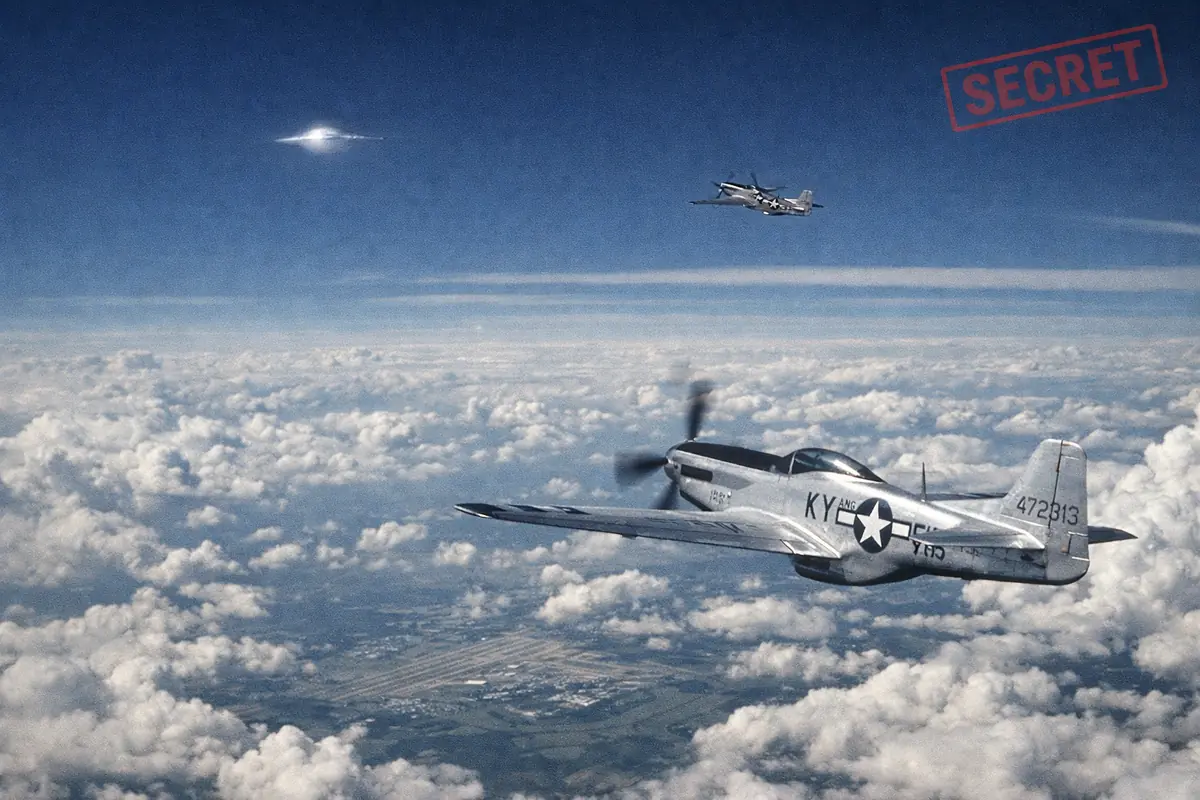
AI-generated illustration used to accompany this article.
Date
January 7, 1948
Location
Godman Field / Fort Knox, Kentucky
Country
United States
Category
Military observation
Status
Investigated
Credibility
79/100
Notoriety
90/100
Coordinates
37.908° N · 85.972° W
Reading note
Why this file still matters
The Mantell case fused the early saucer wave with a fatal military pursuit, which is why it never faded from the record.
Timeline anchors
03
Distinct hypotheses
03
Sources used
03
Long summary
Narrative
A structured reading of the file, attentive to context, witnesses and the public circulation of the case.
On January 7, 1948, several reports converged on Godman Field near Fort Knox, where observers described a bright object visible in broad daylight, fixed or moving only slowly depending on the vantage point. Four P-51s from the Kentucky Air National Guard, returning from a convoy mission, were diverted to investigate. Captain Thomas Mantell took the lead. The surviving radio exchanges show a pilot trying to describe something he could not identify with confidence at a time when the military itself still lacked a stable framework for this kind of alert.
As the climb continued, other aircraft in the formation broke away. Mantell continued upward. The later record converges on one crucial point: his aircraft was not equipped for prolonged very high-altitude flight with oxygen, and contact was lost before he could recover. His P-51 crashed near Franklin. The file immediately became national news because it linked the young flying-saucer wave to the death of a serving military pilot.
The case lasted not only because of the tragedy, but because the explanations kept moving. Venus was suggested early and later judged inadequate; Edward J. Ruppelt and others argued that a secret Skyhook balloon fit the record more convincingly, though not perfectly. Mantell therefore remains one of the earliest instances in which an unidentified observation, a military reaction and a revised official explanation became permanently tied together.
Timeline
Sequence of events
The steps retained here prioritize historical markers and the turning points in the public narrative.
An object is reported over Kentucky
Observers at Godman Field describe a bright object in broad daylight.
Fighters are scrambled
Captain Mantell leads a pursuit that climbs too high for the aircraft's equipment.
The crash and the explanation debate follow
The death of the pilot and the later Venus versus Skyhook arguments keep the case alive.
Hypotheses
Interpretive frameworks
The hypotheses remain distinct from the factual narrative. They organize possible readings without erasing the blind spots.
Likelihood high
Skyhook balloon or other high-altitude balloon
A secret balloon program may explain what the pilots were chasing.
Likelihood medium
Initial misidentification amplified by context
A bright target may have been overread in the rush of pursuit.
Likelihood low
Object genuinely unidentified during the pursuit
The radar-free chase still leaves room for a real anomaly at the time.
Sources
Documents and references
Historical sources, reports, archives and books used to structure this file.
Project Sign and Project Blue Book UFO case files
1948National Archives and Records Administration
Project Sign and Project Blue Book material preserving the military paperwork on the Mantell file.
Open sourceFlying Saucers UFO Reports
1952CIA Reading Room
Early Air Force discussion showing how the crash was folded into the first flying-saucer debate.
Open sourceThe Report on Unidentified Flying Objects
1956Edward J. Ruppelt
Later reference review revisiting the Venus and Skyhook explanations side by side.
Open sourceRelated cases
Related cases
Related cases connected by country, category or historical significance.
Kenneth Arnold Sighting
June 24, 1947 · United States
Arnold's June 1947 report mattered because it gave the postwar world the phrase flying saucer.

Tehran 1976
September 19, 1976 · Iran
Tehran 1976 became a military classic because civilian reports escalated into fighter intercepts and a diplomatic record.

Phoenix Lights
March 13, 1997 · United States
Phoenix Lights lasted because one Arizona night seems to contain both a statewide transit and the famous stationary lights over the city.